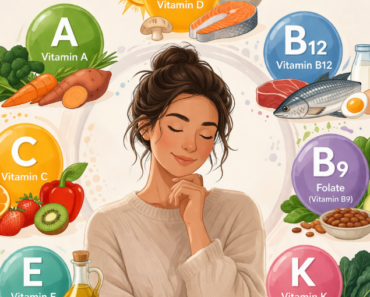
We live in a world of nutritional contradictions. Our grocery stores are overflowing with options, yet modern soil depletion, food processing, and high-stress lifestyles have created a phenomenon known as “hidden hunger.” This is a state where you are consuming enough calories to sustain your weight, but your cells are starving for the micronutrients they need to perform trillions of daily biochemical reactions.
Your body is a master of adaptation. When it lacks essential vitamins, it doesn’t simply stop working; instead, it enters a state of “triage.” It prioritizes your vital organs—your heart, lungs, and brain—while pulling resources away from “non-essential” systems like your hair, skin, and evening energy levels. If you’ve been feeling like you’re running on low battery, these subtle signs might be your body’s way of asking for a nutritional upgrade in your daily routine.
1. The “Pink in the Sink” (Vitamin C Deficiency)
Many people notice a small amount of bleeding when they brush or floss and assume they are simply being too aggressive. However, healthy gum tissue should be resilient. Persistent bleeding is often one of the earliest signs that your collagen synthesis is failing.
Vitamin C is the essential glue that holds your tissues together. It is a critical co-factor for the production of collagen, which strengthens your blood vessels and gums. Because Vitamin C is water-soluble and used rapidly by your adrenal glands during times of stress, your “reserves” can be depleted quickly. If your gums are sensitive or you notice easy bruising on your limbs, your body is signaling that its internal “repair kit” is running low.
2. “Chicken Skin” on the Back of Arms (Vitamin A & Omega-3s)
Have you noticed tiny, rough bumps on the back of your arms or thighs? This condition, known as keratosis pilaris, is often dismissed as a skin quirk. From a nutritional perspective, it is a sign of poor barrier function.
When the body lacks fat-soluble Vitamin A or essential fatty acids, the skin cannot properly regulate the production of keratin. This leads to a buildup around the hair follicles, creating those characteristic “sandpaper” bumps. It’s a signal that your internal membranes—which include your gut lining and your skin—need more high-quality fats and fat-soluble vitamins to maintain their smoothness and integrity.
3. Vertical Ridges on Fingernails (B-Vitamins and Iron)
Your fingernails are like a biological timeline of your health over the last six months. While horizontal ridges can indicate a past illness, vertical ridges that run from the cuticle to the tip are often a sign of malabsorption.
These ridges frequently appear when the body is low on B-vitamins, particularly B12, or iron. As your body prioritizes oxygen delivery to your heart, it reduces the blood flow and nutrient delivery to the “periphery,” such as your nail beds. If your nails are also brittle or slow to grow, it is a clear message that your “nutrient delivery system” is struggling to reach the furthest points of your body.
4. Cracked Corners of the Mouth (B2 and B12)
Waking up with painful cracks or sores at the corners of your mouth (angular cheilitis) is more than an annoyance; it is a specific neurological and metabolic signal. This area of the face is highly sensitive to the levels of B-complex vitamins, especially Riboflavin (B2) and B12.
These vitamins are essential for the health of your mucous membranes and for the production of energy within your cells. If you are also experiencing a “burning” sensation on your tongue or unusual fatigue, your body is likely signaling that your methylation pathways—the chemical “switches” that turn on health—are not firing correctly due to a lack of B-vitamin support.
5. Night Vision Issues and Digital Strain (Vitamin A)
Do you find it increasingly difficult to drive at night or adjust your eyes when moving from a bright room to a dark one? While we often blame “screen time,” the ability of your eyes to adapt to low light is a nutrient-dependent process.
The retina requires Vitamin A to produce rhodopsin, the pigment that allows you to see in low-light conditions. In our modern world, the constant exposure to high-intensity blue light from screens can accelerate the “burn rate” of Vitamin A in the eye. If your eyes feel perpetually dry or “sandy,” it’s a sign that your visual system needs more antioxidant support to recover from the daily digital load.
6. The “Brain Fog” and Emotional Friction (Vitamin D and B6)
We often attribute our mood swings or “cloudy” thinking to a bad day or a lack of sleep. However, your neurotransmitters—the chemicals that govern your mood—are built from vitamins.
Vitamin D acts as a master hormone that regulates the conversion of tryptophan into serotonin, the “feel-good” neurotransmitter. Simultaneously, Vitamin B6 is required for the production of dopamine and GABA (the “calm” neurotransmitter). If you feel “emotionally thin” or struggle to focus on complex tasks, your body might be signaling a neuro-chemical imbalance caused by a lack of these essential co-factors.
7. Frequent Muscle Twitches or Eyelid Tremors (Magnesium)
Perhaps the most common “whisper” of the modern era is the annoying eyelid twitch or the sudden leg cramp during the night. These are not random glitches; they are signals of electrolyte instability.
Magnesium is responsible for muscle relaxation and nerve transmission. Because magnesium is “burned” at a high rate when we consume caffeine, sugar, or experience stress, most modern daily routines lead to a deficit. A twitching eye is your nervous system’s way of begging for a “reset” and a replenishment of the minerals that keep your electrical signals flowing smoothly.
Bridging the Gap
Identifying these signs is the first step toward reclaiming your vitality. However, the solution isn’t just about taking a random multivitamin. True wellbeing comes from bioavailability—choosing nutrient-dense whole foods and high-quality, science-backed supplements that your body can actually absorb.
The Bottom Line: Your body doesn’t want to fail; it wants to thrive. These daily signs are invitations to slow down, audit your nutrition, and provide your system with the raw materials it needs to move from “survival mode” back into “thrive mode.” Listen to the whispers of your nails, your skin, and your energy today, so you can enjoy a more vibrant tomorrow.
Disclaimer: This content is for informational purposes only and does not constitute medical advice. Nutrient deficiencies should be confirmed with proper blood work and consultation with a healthcare professional. Always seek the advice of your physician or other qualified health provider with any questions you may have regarding a medical condition.