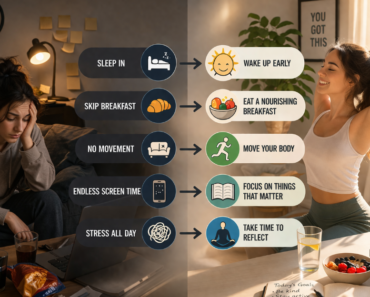
In our fast-paced society, we are conditioned to look for the “quantum leap”—the 30-day transformation, the miracle diet, or the overnight success. We often overlook the subtle, seemingly insignificant actions we take between waking up and going to sleep. However, biology doesn’t work in leaps; it works in increments.
Just as a small rudder turns a massive ship over a long journey, small daily habits create a “compounding effect” in your physiology. Over weeks, months, and years, these micro-adjustments dictate your metabolic age, your cognitive resilience, and your overall vitality. If you want to change your health trajectory without an exhausting overhaul, focus on these small changes that yield massive biological dividends.
1. The “First 10” Sunlight Rule
One of the smallest changes with the largest impact is spending the first ten minutes of your day outside. Most people wake up and immediately turn on overhead LED lights or look at a smartphone. This sends a “low-quality” signal to your brain about the time of day.
The Big Difference: When you step outside and allow natural, full-spectrum light to hit your retinas, you trigger a precise hormonal cascade. This suppresses melatonin and sets a timer for its release 16 hours later. It also boosts serotonin production, which governs your mood and appetite. Over time, this simple habit stabilizes your circadian rhythm, leading to deeper sleep and more consistent energy levels without the need for extra caffeine.
2. The “Vinegar Primer” Before Large Meals
If you aren’t ready to change what you eat, change how you start the meal. Taking one tablespoon of apple cider vinegar diluted in a tall glass of water 10 to 15 minutes before your largest meal is a tiny change that transforms your internal chemistry.
The Big Difference: The acetic acid in the vinegar temporary inhibits the enzymes that break down starches. This leads to a significantly smaller glucose spike after you eat. By flattening your glucose curve, you prevent the massive insulin surges that lead to fat storage and systemic inflammation. Over months, this small “primer” can improve insulin sensitivity and reduce the persistent “brain fog” that often follows a heavy lunch.
3. “Box Breathing” During Transitions
We often carry the stress of one task into the next. You finish a stressful email and immediately jump into a meeting, carrying that “high-cortisol” state with you. A small change is to implement 60 seconds of “Box Breathing” (inhale for 4, hold for 4, exhale for 4, hold for 4) between tasks.
The Big Difference: This technique directly stimulates the vagus nerve, the “on-off switch” for your parasympathetic nervous system. It tells your brain that despite the deadlines, you are safe. This lowers your resting heart rate and prevents your body from staying in a chronic “fight or flight” mode. Over time, this prevents “adrenal burnout” and keeps your immune system robust, as the body only performs deep repair when it feels secure.
4. Prioritizing “Vertical Movement” (NEAT)
You don’t need a grueling hour at the gym to change your metabolic health. A small change is to prioritize “vertical movement”—taking the stairs instead of the elevator, or standing up for five minutes every hour. This falls under NEAT (Non-Exercise Activity Thermogenesis).
The Big Difference: Vertical movement engages the large muscle groups in your legs and glutes, which act as “metabolic sinks” for excess blood sugar. Studies show that these short bursts of activity can be just as effective for long-term cardiovascular health as a single, stationary workout. Over time, increasing your NEAT prevents the metabolic slowdown associated with sedentary office work.
5. The “Caffeine Buffer” Habit
Most of us reach for a cup of coffee the moment our eyes open. A small but powerful change is to delay that first cup by just 90 minutes.
The Big Difference: When you wake up, your body is still clearing out adenosine, the chemical that builds up in your brain to make you feel sleepy. If you block those receptors with caffeine too early, the adenosine stays “parked” and rushes back in the moment the caffeine wears off, causing the dreaded 2:00 PM crash. By waiting 90 minutes, you allow your body to clear the fog naturally. The result? You’ll find you need less caffeine overall and your afternoon focus becomes unshakable.
6. The “3-2-1” Evening Wind-Down
The final hours of your day dictate the quality of your cellular repair. A small change is the “3-2-1” rule: No food 3 hours before bed, no work 2 hours before bed, and no screens 1 hour before bed.
The Big Difference: Stopping food three hours before sleep allows your body to focus on autophagy (cellular cleaning) rather than digestion. Removing screens one hour before bed allows your natural melatonin to rise, ensuring you enter the “deep sleep” stages where your brain flushes out metabolic waste. Over time, this routine act of “nightly maintenance” significantly reduces the risk of cognitive decline and keeps your metabolism sharp.
7. Strategic Hydration with Sea Salt
Many people drink plenty of water but still feel dehydrated. A small change is adding a tiny pinch of high-quality sea salt to your morning water.
The Big Difference: Pure, filtered water can sometimes “wash out” minerals from your cells. Sea salt contains trace minerals like magnesium, potassium, and sodium, which act as the “keys” that allow water to enter your cells. This improves cellular hydration, leading to better skin elasticity, fewer headaches, and more efficient nerve signaling. You aren’t just “drinking” water; you are actually absorbing it.
The Power of the Long Game
None of these changes require a gym membership, a kitchen overhaul, or a massive time commitment. They are “micro-investments” in your biological bank account. Because they are easy to do, they are easy to keep doing. And in the world of health, consistency is the ultimate force multiplier.
The Bottom Line: Don’t underestimate the “small.” When you master your daily light, your breath, and your timing, you aren’t just changing your day—you are changing your future. Start with one of these shifts tomorrow, and let the power of compounding take care of the rest.
Disclaimer: This content is for informational purposes only and does not constitute medical advice. Small habit changes should be discussed with a healthcare professional if you have underlying conditions. Always seek the advice of your physician or other qualified health provider with any questions you may have.