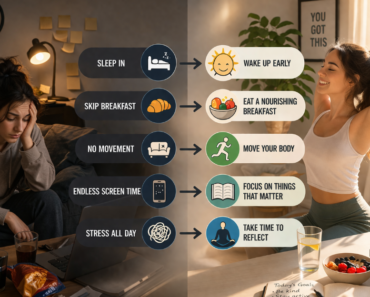
We often treat our personal energy like a bank account. We assume that as long as we “deposit” eight hours of sleep at night, we should have a full balance to spend the next day. However, many of us wake up feeling bankrupt before we’ve even finished our first cup of coffee. We blame our age, our demanding jobs, or our busy schedules, but the truth is often found in the “micro-leaks” of our daily routines.
Energy isn’t just about how much you sleep; it’s about how efficiently your body produces and preserves its primary fuel source: ATP (Adenosine Triphosphate). If you find yourself hitting a wall by mid-afternoon, it’s time to perform an energy audit. Here are eight subtle daily habits that are likely draining your battery without you even realizing it.
1. The “Digital Sunrise” Routine
The moment your eyes open, your brain is in a delicate transition state. Reaching for your smartphone before you’ve even stepped out of bed is one of the most aggressive energy drains. This “Digital Sunrise” floods your brain with blue light and a dopamine-driven “hit” of notifications, emails, and news.
Biologically, this spikes your cortisol levels too early and forces your brain into a reactive, high-stress “Beta” wave state. By the time you actually start your workday, your mental focus is already partially depleted from processing a sea of irrelevant information. Try giving your brain a 30-minute “buffer zone” of natural light and movement before touching a screen.
2. The “Caffeine Crutch” Timing
Caffeine doesn’t actually create energy; it simply blocks the receptors in your brain that tell you you’re tired. The habit of drinking coffee the second you wake up can actually lead to a massive energy crash later.
When you wake up, your body is naturally clearing out adenosine (the chemical that makes you sleepy). If you introduce caffeine immediately, you interfere with this natural clearance process. Furthermore, caffeine has a half-life of about five to six hours. If you have a “pick-me-up” cup at 4:00 PM, a quarter of that caffeine is still buzzing in your system at 10:00 PM, sabotaging the deep, restorative stages of your sleep.
3. Shallow “Chest Breathing”
Most adults breathe from their upper chest rather than their diaphragm. This habit, often triggered by sitting at a desk or feeling stressed, sends a signal to your nervous system that you are in a state of “low-level panic.”
Shallow breathing limits the amount of oxygen reaching your cells and keeps your body in a sympathetic nervous system state (fight or flight). This consumes an enormous amount of metabolic energy. Learning to take “belly breaths”—where your abdomen expands—tells your brain it is safe to switch to the parasympathetic mode, which preserves energy and improves mental clarity.
4. The “Open Tabs” Mentality (Multitasking)
Our brains are not designed to multitask; they are designed to “task-switch” rapidly. Every time you jump from an email to a text message, and then back to a project, your brain burns through a significant amount of oxygenated glucose.
This cognitive friction is like driving a car and constantly slamming on the brakes only to floor the accelerator again. By the end of the day, you aren’t just tired; you are “brain fried.” This mental exhaustion often translates into physical lethargy. Focusing on one single task for 25-minute intervals can save you hours of “energy leakage.”
5. Invisible Dehydration
By the time you feel thirsty, your body is already significantly dehydrated. Even a 1% to 2% drop in hydration levels can lead to a noticeable decline in cognitive function and physical stamina.
When you are dehydrated, your blood volume decreases, which means your heart has to pump harder to get oxygen and nutrients to your brain and muscles. This extra effort by your cardiovascular system is a silent energy drain. Keeping a glass of water on your desk isn’t just about thirst; it’s about maintaining the “viscosity” of your internal transport system.
6. The “Sugar Rollercoaster” Breakfast
If your breakfast consists of toast, cereal, or a pastry, you are setting yourself up for an energy bankruptcy by noon. These high-glycemic carbohydrates cause a rapid spike in blood sugar, followed by a massive surge of insulin.
The resulting “sugar crash” leaves you feeling shaky, irritable, and desperate for another snack. To maintain a steady energy “burn” throughout the day, your first meal should prioritize healthy fats and proteins. This creates a slow-release energy profile that keeps your mitochondria happy and your focus sharp.
7. Sedentary Stagnation
It seems counterintuitive: how can not moving drain your energy? The human body is a “use it or lose it” system. When you sit for hours at a time, your circulation slows, and your muscles send signals to the brain that “power-saving mode” should be activated.
Movement is a signal to your mitochondria—the power plants of your cells—that they need to produce more ATP. Even a five-minute walk or a quick set of stretches every hour can “re-prime” your metabolic pump and prevent that heavy, stagnant feeling that comes from a sedentary workday.
8. Making Too Many Trivial Decisions
“Decision fatigue” is a real biological phenomenon. Your brain has a limited amount of energy to spend on choices every day. If you spend your morning debating what to wear, what to eat for lunch, or which email to answer first, you are draining the “battery” that you need for high-level problem-solving later.
Highly successful people often automate these trivial choices (like having a “work uniform” or meal-prepping) to preserve their prefrontal cortex energy for things that actually matter.
Plugging the Leaks
The path to vibrant energy isn’t always about adding new supplements or bio-hacks; it’s often about removing the habits that are quietly siphoning your vitality. Start by picking just two of these “leaks” to plug this week. Whether it’s delaying your phone use or changing the timing of your coffee, you’ll likely find that you had plenty of energy all along—you were just letting it slip through the cracks.
Disclaimer: This content is for informational purposes only and does not constitute medical advice. Chronic fatigue can be a symptom of various underlying health conditions. Always seek the advice of your physician or other qualified health provider with any questions you may have.